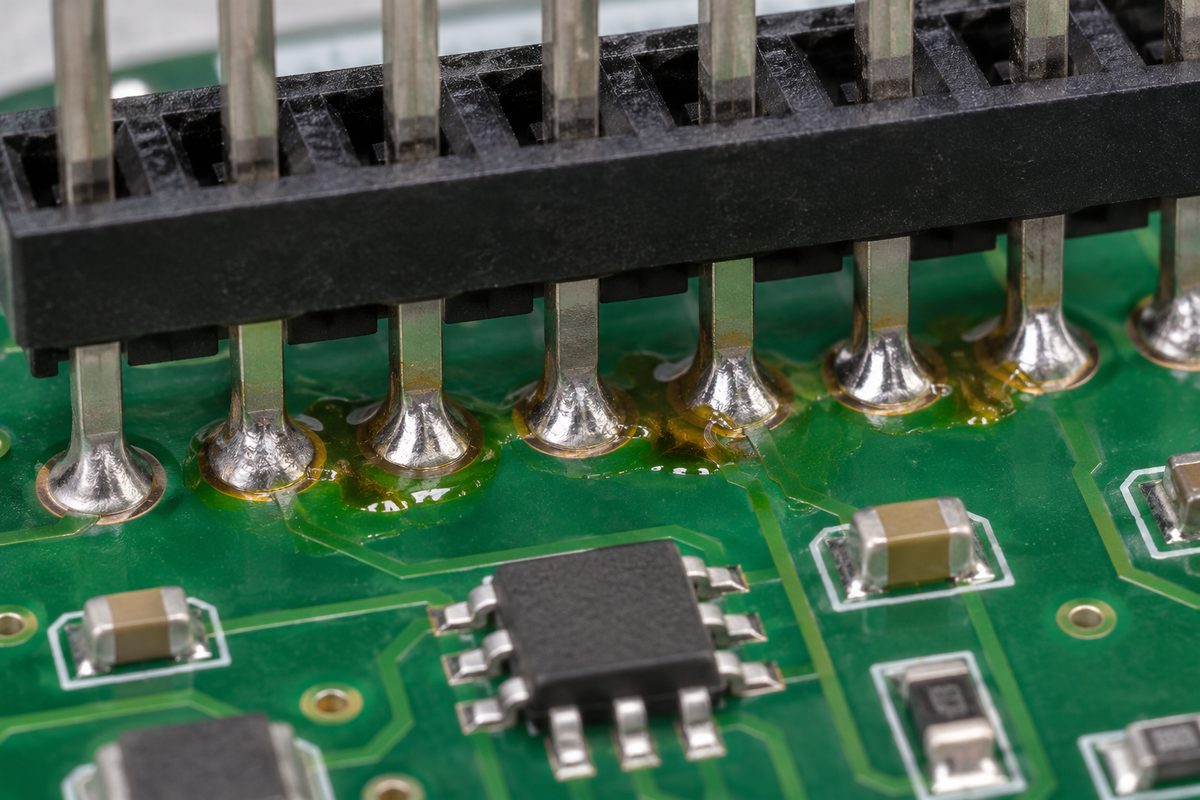
Solder flux removes surface oxides during heating so molten solder can wet a joint. Choosing it requires more than picking a liquid, gel or “no-clean” label: the chemistry must fit the soldering process, the assembly must tolerate any required cleaning, and the remaining residue must be acceptable for its use environment. Select the material and its processing route together, then validate them on a representative assembly before changing production.
Start Solder Flux Selection With the Job, Not the Container
Identify the soldering operation and the final assembly requirements before choosing a flux form. Wave soldering needs controlled liquid delivery; local rework may need a material that stays near the joint. A liquid flux, tacky flux and flux-bearing solder paste are not interchangeable just because they all assist wetting.
Record the alloy, finish, component restrictions, heating method, cleaning access and downstream coating or testing. For a basic explanation of oxide removal, see what solder flux does. The decision here is whether a specific material/process combination can be released, not whether flux is useful.
Separate Chemistry, Activity, Form and Cleaning Labels
Flux labels describe different properties, so “rosin,” “gel” and “no-clean” are not three mutually exclusive chemistries. Read each dimension separately.
| Label dimension | Examples | Decision it supports |
| Composition family | RO, RE, OR, IN | Rosin, resin, organic or inorganic classification; confirm electronics suitability |
| Activity classification | L, M or H within a J-STD-004 code | Screen activity, then review actual product/process data |
| Delivery form | Liquid, tacky gel, flux core | Match dispensing and access to the operation |
| Residue/cleaning route | No-clean or water-soluble | Decide whether the proposed processing and residue state are acceptable |
The final 0 or 1 in a classification concerns halide classification under the referenced standard; it is not a universal statement about every halogen-containing substance or absolute analytical zero. Use the product’s declared test basis. Coilcraft’s flux-selection note explains why composition and activity must be considered with the component and cleaning process.
Detailed Product Parameters: Three Liquid Flux Examples
Compare named products with their stated units and conditions, not generic “low” and “high” scores. These published Kester bulletin values are examples for interpreting datasheets, not approved incoming specifications or a recommendation to substitute one product for another.
| Published property | Kester 951 | Kester 959T | Kester 2331-ZX |
| Intended route | Low-solids, no-clean liquid | Low-solids, no-clean liquid | Organic water-soluble liquid |
| Declared classification | ORL0, J-STD-004 | ORL0, J-STD-004B | ORH1, J-STD-004B |
| Solids | 2.0%, theoretical | 2.9%, typical | 33%, theoretical |
| Specific gravity at 25°C | 0.814 | 0.794 ± 0.005 | 0.899 ± 0.005 |
| Acid number | 14.3 mg KOH/g flux, typical | 21.0 ± 1.0 mg KOH/g flux | Not supplied in the cited parameter summary |
Sources: 951 bulletin, 13 May 2021; 959T bulletin, 17 February 2021; 2331-ZX manufacturer bulletin. Specific gravity is dimensionless. Typical and theoretical values are not automatically guaranteed limits. Obtain the current controlled TDS and SDS before procurement or process release.
No-Clean vs Water-Soluble: Choose the Complete Route
Choose a no-clean route when the specific residue and processing conditions are qualified; choose a water-soluble route only when the required washing, rinsing and drying can be completed on the assembly. Neither label alone establishes reliability.
The examples expose two traps. First, 951 and 959T share ORL0 but differ in solids and other properties, so their dispensing settings cannot be assumed identical. Second, 2331-ZX’s neutral-pH description does not make it a no-clean material. Chemistry descriptions, cleaning instructions and application approval answer different questions.
More activity is not automatically better. A material that wets an oxidized test coupon may be unsuitable for a component that traps chemistry or cannot tolerate washing. Compare the whole route, including reject risk and cleaning access, rather than the bottle price alone.
Control Delivered Solids, Not Just Wet Flux Volume
Equal wet delivery does not mean equal flux-solids delivery. For a mass-based estimate, deposited solids = wet flux mass × solids mass fraction. Volume-based dispensing additionally requires an appropriate density conversion and calibration.
In a hypothetical comparison, 0.100 g of a 2.0% solids material contains 2.0 mg of solids, while the same wet mass at 33% contains 33 mg. The 16.5-fold difference explains why copying a dispenser setting can be misleading. This is arithmetic using the two cited concentrations, not a recommended dose or measured board result.
Input solids are not the same as final post-heating residue. Indium’s residue discussion identifies thermal conditions and measurement basis as reasons residue quantities differ. Keep incoming concentration, applied mass and final residue separate in the process record.
Match the Flux to the Real Thermal and Dispensing Process
Use the selected product’s process guidance and verify it on the actual equipment and assembly. A wave-soldering liquid is not automatically a suitable substitute for a rework gel, and a hot-tool setpoint is not the measured temperature history of every fluxed area.
Check coverage, repeatability, preheat or reflow exposure, and whether material spreads beyond the region receiving the intended heating. Do not compensate for contaminated surfaces or poor heat transfer by flooding the board. Keep alloy and component thermal restrictions in the same review. Kester’s 951 bulletin identifies acid-number measurement as a concentration-control method for that low-solids system; it does not authorize adding arbitrary solvent to any flux.
Check Cleaning Access Before Selecting Aggressive Chemistry
A cleaning requirement is practical only if the process can remove residue from the places it enters. Review low-standoff components, connectors, coils and enclosed structures before choosing a wash-required flux.
Coilcraft warns that chemistry can enter fine-wire components and become trapped; cleaning can also move residue farther into a winding. This is a component/process compatibility issue, not proof that every water-soluble product is unusable. Check the exact component guidance and qualify the full sequence. If a required wash conflicts with a component restriction, change the material, process sequence or component choice before release.
Decide Whether No-Clean Residue Is Acceptable Electrically
Accept retained residue against the assembly’s electrical and environmental requirements, not its appearance alone. Consider sensitive nodes, conductor spacing, humidity exposure and the actual process history when choosing representative verification.
A supplier’s surface-insulation-resistance result applies to its documented test conditions. It is useful material evidence, but not a complete qualification of every board geometry or mixed-chemistry rework sequence. Where leakage or corrosion risk matters, define suitable test structures, exposure conditions and acceptance criteria with the responsible engineering and quality team. Do not claim that a visually clean board or a quick continuity check proves long-term insulation performance.
Include Rework Chemistry in the Qualification Boundary
Qualify the complete sequence of materials a finished board receives, including touch-up flux and flux-core wire. Approving the main production flux does not automatically approve an added pen or gel.
List the main flux or solder paste, wire-core chemistry, separate rework flux, cleaner and any coating. Evaluate the combined residue state and processing sequence. A locally reheated joint may leave nearby applied material outside the intended thermal exposure. If compatibility data are missing, do not assume two products can be mixed because both say “no-clean.” Obtain supplier guidance or run a controlled qualification instead of treating a successful first joint as release evidence.
Verify Coating, Potting and Test-Probe Compatibility
Check downstream operations explicitly because a residue acceptable on an uncoated board may still interfere with another process. Review coating adhesion and coverage, potting compatibility, and electrical test contact behavior.
Coilcraft calls for flux/coating compatibility testing rather than a blanket material-family approval. Indium explains that no-clean residue removal, when required, needs a chemically compatible cleaning agent. A poorly matched wipe can redistribute material rather than establish cleanliness. Use representative assemblies and the actual downstream materials; a clean-looking open coupon does not reproduce every hidden surface.
Troubleshoot the Symptom Before Changing Flux
Identify which process variable failed before increasing activity or temperature. The following are candidate causes and discriminating checks, not diagnoses from appearance alone.
| Symptom | Possible contributors | Check before changing chemistry |
| Solder beads or incomplete wetting | Oxides, contamination, heat transfer, flux delivery | Surface condition, joint temperature history and coverage |
| Sticky or excessive residue | Over-application, formulation, inadequate processing | Applied amount and actual product/thermal instructions |
| White film after cleaning | Partial dissolution, redeposition or material interaction | Cleaner compatibility, removal/rinse sequence and remaining contamination |
| Unstable test contact or leakage | Residue location, probe contamination or electrical/environmental sensitivity | Probe condition and an appropriate contamination/insulation investigation |
| Coating dewetting or poor adhesion | Surface contamination or material incompatibility | Qualified cleaning and coating compatibility on the actual assembly |
Stop unqualified chemical or thermal changes when component compatibility is unknown. Follow the relevant SDS for handling, ventilation, ignition control and disposal; a flux family name is not a safety instruction.
Release a Flux Change With a Reusable Evidence Checklist
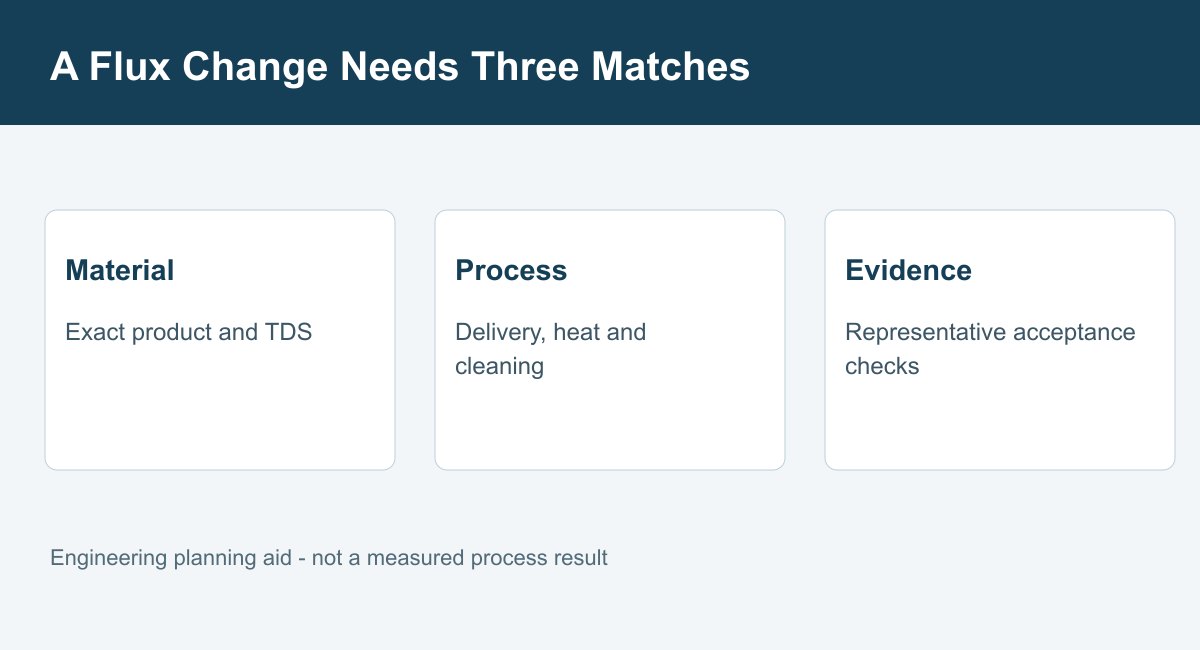
Release the change only when material identity, processing conditions and acceptance evidence agree. Use a short change record rather than a verbal statement that the new flux “works better.”
- Identify the exact product, lot, TDS revision, SDS and approved application.
- Record alloy, finish, relevant components, board revision and application equipment.
- Define controlled delivery and the verified thermal sequence, including rework.
- Record the cleaning decision, access limitations and downstream coating or testing.
- Evaluate wetting, defects, residue and the electrical/environmental checks required by the product.
- Approve limits and change authority; retain results and define what future changes trigger requalification.
FAQ
Does solder flux expire even when it still looks usable?
Use the manufacturer’s shelf life and storage conditions rather than appearance alone. For example, the cited 951 bulletin specifies one year from manufacture when properly handled at 10–25°C. Other products differ. Quarantine material with unknown age or storage history until its disposition is approved.
Does water-soluble mean the liquid contains only water?
No. The term describes a cleaning property of the formulation or residue, not a guarantee about the carrier or flammability. Check the exact TDS and SDS. Do not add water to a flux tank or substitute a storage method based only on that label.
Why can alcohol leave a white film instead of removing residue?
The cleaner may dissolve only part of the residue, move it to a new area or interact with another material. White appearance alone does not identify the cause. Check the flux manufacturer’s cleaner recommendation and verify removal, rather than repeatedly spreading dissolved material with the same wipe.
Is paste flux the same material as solder paste?
No. Paste or tacky flux supplies flux chemistry but not the solder-alloy powder needed to form a joint. Solder paste combines metal powder with a flux system. Confirm the actual product description before selecting it for printing, dispensing, rework or a purchasing substitution.
Can a flux be approved without a manufacturer datasheet?
Not responsibly for a controlled production change. Without traceable identity, processing instructions and residue information, the engineer cannot define a reproducible route. An attractive label or a successful repair is not equivalent evidence. Request the documents or select a traceable candidate before qualification.
Does a neutral pH prove the residue is harmless?
No. pH and acid number are different measurements, and neither alone establishes residue reliability after soldering. The cited 2331-ZX product is described as neutral-pH but remains a water-soluble flux with its own processing requirements. Read the cleaning and test information instead of approving it from one descriptor.
Can one no-clean flux replace another with the same code?
The shared classification is a starting point, not a drop-in compatibility statement. Compare delivery, solids, thermal guidance, residue behavior and downstream materials. The 951 and 959T examples show different physical properties despite ORL0 labels. Validate the proposed substitution under the actual assembly process before approval.
Can plumbing flux be used if the board will be washed?
Do not substitute plumbing flux for an electronics-qualified material merely because cleaning is planned. Its intended metals and chemistry may be unsuitable for the assembly, and washing does not automatically establish compatibility. Choose a documented electronics product and verify its process against the board and component requirements.
Sources and Application Limits
The product values above come from manufacturer bulletins, not Best Technology production measurements. Additional references include Chemtronics’ electronics-flux guide, the linked Coilcraft component guidance and Indium’s flux/residue explanations. Classification references retain the revisions declared by those documents; this article does not claim they are the latest standard editions.
For an assembly project review, send the board revision, BOM, solder alloy, proposed flux TDS, cleaning restrictions and required acceptance evidence to [email protected]. Material substitution and test scope need project-specific approval.
Tags: assembly qualification, flux selection, no-clean flux, solder flux
PakarPBN
A Private Blog Network (PBN) is a collection of websites that are controlled by a single individual or organization and used primarily to build backlinks to a “money site” in order to influence its ranking in search engines such as Google. The core idea behind a PBN is based on the importance of backlinks in Google’s ranking algorithm. Since Google views backlinks as signals of authority and trust, some website owners attempt to artificially create these signals through a controlled network of sites.
In a typical PBN setup, the owner acquires expired or aged domains that already have existing authority, backlinks, and history. These domains are rebuilt with new content and hosted separately, often using different IP addresses, hosting providers, themes, and ownership details to make them appear unrelated. Within the content published on these sites, links are strategically placed that point to the main website the owner wants to rank higher. By doing this, the owner attempts to pass link equity (also known as “link juice”) from the PBN sites to the target website.
The purpose of a PBN is to give the impression that the target website is naturally earning links from multiple independent sources. If done effectively, this can temporarily improve keyword rankings, increase organic visibility, and drive more traffic from search results.
