If you are working on an RF or microwave PCB design, the materials you choose have a direct impact on signal loss, phase stability, thermal performance, and overall system reliability. Rogers RO4350B is one of the most widely used high-frequency laminates in telecommunications, radar, 5G, satellite and advanced wireless systems. This guide provides complete details on RO4350B datasheet properties, thickness options, RF advantages, and comparison to FR4—plus practical manufacturing notes for PCB engineers.
What Is Rogers RO4350B Material?
Rogers RO4350B is a glass-reinforced hydrocarbon-ceramic laminate designed for RF and microwave applications from the Rogers RO4000® series. Unlike PTFE-based laminates, RO4350B can be manufactured using standard FR4 PCB processes—a major advantage in terms of cost, lead time, and manufacturability—while still providing excellent electrical stability at GHz frequencies.
Main characteristics:
- Dk = 3.48 ± 0.05 (10 GHz, z-axis)
- Df ≈ 0.0037 (low loss)
- High thermal stability
- Low moisture absorption (<0.06%)
- Compatible with FR4 process
- Excellent for hybrid stacks
What Is Rogers RO4350B Material?
What is the RO4350B Used for in RF PCB Applications?
The RO4350B is found in almost every modern RF system. Common uses include:
- 5G antenna and base station
- Phased array radar module
- LNA, PA, and front-end RF chain
- Power amplifiers require strong thermal pathways
- Filters, couplers, baluns and RF matching networks
- Automotive ADAS radar
- Satellite communications module
- High performance mixed signal and RF/digital hybrid boards
Because it balances cost and performance, the RO4350B is ideal for medium to high volume RF production.
Rogers RO4350B Data Sheet: Complete Material Properties Overview
Below is a combined summary of all the important RO4350B data sheet values that RF engineers often use in simulations, builds, and production records.
RO4350B Electrical Properties
| Owned by | Typical Value | Test Conditions/Notes |
| Dielectric Constant (Dk) | 3.48 | Measured at 10GHz |
| Dielectric Constant Stability | ±0.05 | Across the entire thickness range |
| Temperature Coefficient Dk | +50 ppm/°C | −50°C to +150°C |
| Dissipation Factor (Df) | 0.0037 | @ 10GHz |
| Volume Resistivity | 1×10⁷ MΩ·cm | ASTM D257 |
| Surface Resistivity | 1×10⁷ MΩ | ASTM D257 |
| Dielectric Strength | 40 kV/mm | Typical |
| Electricity Loss Stability | Very good | Use of wideband RF |
RO4350B Thermal Properties
| Owned by | Typical Value | Notes |
| Thermal Conductivity | 0.69 W/m·K | Supports heat spreading feature |
| Tg (Glass Transition Temperature) | >280°C | Very stable for lead free |
| Td (Decomposition Temperature) | ≈390°C | Rogers method |
| CTE (X-axis) | 11 ppm/°C | Strong dimensional stability |
| CTE (Y axis) | 14 ppm/°C | Panel reliability is good |
| CTE (Z axis) | 32 ppm/°C | Supports plated through-hole reliability |
| Time T260 | >60 minutes | Anti-delamination performance |
| T288 Time | >20 minutes | High thermal resistance |
RO4350B Copper Option
| Copper Type | Thickness | Notes |
| Rolled Copper | ½ oz, 1 oz | Better for low loss RF channels |
| Electrolytic Copper | ½ ounce, 1 ounce, 2 ounces | Standard PCB production |
| Reverse Treated Copper | Available | Increased adhesion to hybrid stacks |
For more details on the Rogers RO4350B, click here: Download the Rogers RO4350B Data Sheet
RO4350B Thermal Conductivity
RO4350B’s thermal conductivity of 0.69 W/m·K is significantly higher than typical FR4 (~0.3 W/m·K).
It means:
- Better heat distribution
- Higher reliability under RF power load
- Increased board life during thermal cycling
- Lower risk of delamination
This makes the RO4350B a strong candidate for RF power amplifiers and high current density modules.
RO4350B Thickness Options & General Stacking Options
RO4350B thickness availability is wide, giving designers flexibility.
General RO4350B Thickness
- 0.101mm / 0.004”
- 0.203 mm / 0.008”
- 0.254 mm / 0.010”
- 0.3048mm / 0.012”
- 0.406 mm / 0.016”
- 0.508 mm / 0.020”
- 0.813 mm / 0.032”
- 1.524mm / 0.060”
Copper options: ½ ounce, 1 ounce, 2 ounce.
General Stack-up Approach
1. RF dedicated board:
Single RO4350B core for antenna, filter or coupler.
2. Hybrid stack (RO4350B + FR4):
- RF coating on RO4350B
- Digital/Power Layer on FR4
- Best cost-performance balance
3. Multilayer RO4350B array:
For radar, high power, or mmWave systems that require uniform RF behavior.
RO4350B vs FR-4: RF Performance Differences
FR-4 is a good material for general purposes but struggles in the higher RF bands. Its dielectric constant changes with humidity, temperature, and frequency. Loss levels increase significantly above 1–2 GHz, affecting range, efficiency, and signal clarity.
The RO4350B addresses these issues with stable electrical behavior, low losses, and stronger impedance control.
| Feature | RO4350B | FR-4 |
| Stability Dk | Very stable | Unstable at high frequencies |
| Loss (Df) | Low | Tall |
| High frequency use | Very good | Limited |
| Thermal stability | Strong | Currently |
| RF performance | Consistent | Very varied |
| Common use | RF, microwave, antenna | General electronics |
For RF paths, the RO4350B is almost always the better choice.
Overview of Rogers 4000 Series Materials
The RO4000® Series includes hydrocarbon-ceramic laminates designed for RF and microwave work. The series offers stable dielectric values, low water absorption and predictable performance across the entire frequency range. These materials support antennas, filters, couplers, radar units, medical sensors, and industrial communications systems. The RO4003C and RO4350B are the most common choices, although other variants are available for special electrical or mechanical needs. Here are some other RO4000® series materials:
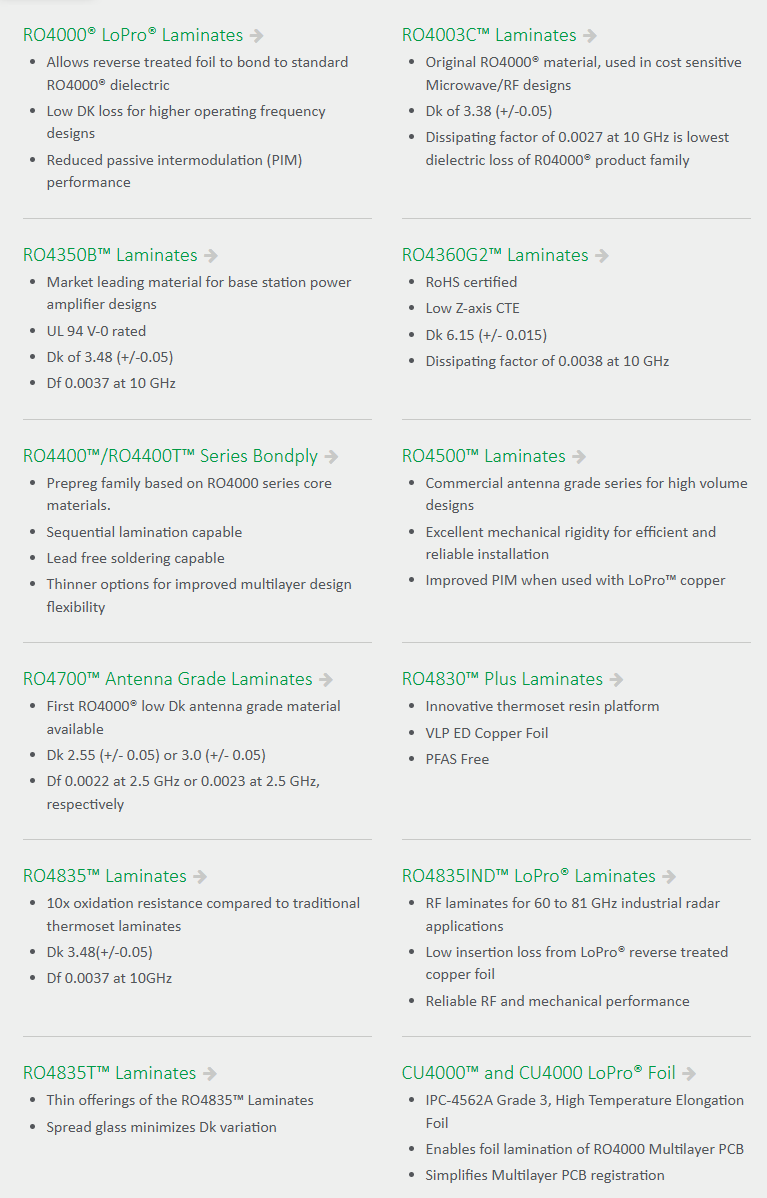
Which Rogers Materials Can Be Used for RF & Microwave PCBs?
Common Rogers RF materials include:
- RO4350B – balanced performance, can be processed like FR4
- RO4003C – lower loss, good for 10+ GHz
- RO4835 – increases oxidation resistance and stability
- RT/duroid® series – PTFE-based ultra-low-loss material for mmWave
- TMM® Series – ceramic thermoset laminate for precise, high-power RF
Select based on frequency, thermal load and tolerance requirements.
RO4350B PCB Manufacturing Considerations
Although RO4350B easier to manufacture than PTFE materials, achieving consistent RF performance requires specific process guidelines to be followed. Here are the main considerations for PCB fabrication:
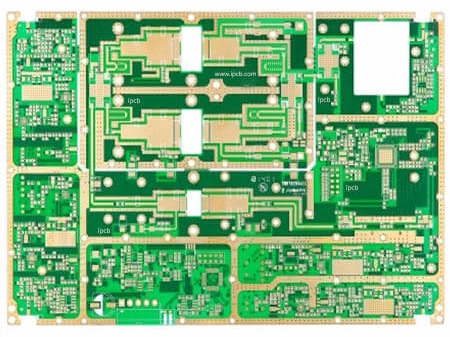
RO4350B PCB Manufacturing Considerations
1. FR4 compatible processing, but with controlled parameters
The RO4350B supports standard PCB processes, but drilling speed, lamination pressure, baking profile and final copper thickness must be carefully controlled to ensure stable impedance and dielectric consistency.
2. Hybrid stacking requires expert laminate control
When combining RO4350B with FR4, the difference is CTE (coefficient of thermal expansion) must be managed to avoid warping, resin deficiency, or delamination. Selection of the correct prepreg and lamination cycle is very important.
3. Accurate impedance control is essential
RF designs often require ±5% or tighter impedance tolerance. Manufacturers must take into account:
- dielectric thickness tolerance
- copper roughness
- vias filled with resin or drilled back
- line width compensation
Providing simulation models or stack records (Dk/Df @ frequencies) helps ensure fabrication accuracy.
4. Drilling & plating demands stricter control
The ceramic-filled structure of the RO4350B requires optimized drilling parameters to prevent tarnishing and maintain high hole wall quality, ensuring reliability through coating for multilayer RF PCBs.
5. Proper storage and handling of materials
To prevent water absorption and dimensional shifts, materials should be stored in a dry, controlled environment and baked before being laminated when necessary.
With these practices, the RO4350B PCB can achieve repeatable RF performance from prototype to mass production.
Why is the Best Technology Preferable for RO4350B PCB Fabrication?
When working with the RO4350B, choosing the right PCB manufacturer is critical. Best Technology trusted by RF engineers because:
- They RO4350B stock in various thicknesses
- Provide RF stack simulation support
- Offer strict impedance control with a test coupon
- Do high precision routing and controlled depth milling
- Support multilayer RO4350B + FR4 hybrid
- Provide material certification and Rogers-lot traceability
If you need consistent RF performance from prototype to mass production, Best Technology is a reliable partner RO4350B PCB Fabrication.
FAQs
1. Does the RO4350B support buried or blind vias in multilayer RF boards?
Yes. The RO4350B performs well in multilayer designs using blind or buried vias. Its mechanical strength and low z-axis expansion help maintain reliability during lamination and thermal cycling. When designers use selective RO4350B layers in a hybrid stack, careful laminate scheduling helps control movement and keep impedance stable.
2. Is the RO4350B compatible with ENIG, immersion silver or HASL finishes?
Yes. The RO4350B supports common surface finishes, including ENIG, immersion silver, OSP, and certain types of lead-free HASL. Most RF boards use ENIG or immersion silver because this finish provides a cleaner surface, consistent thickness, and smoother edges. The smooth finish helps reduce signal loss at high frequencies. HASL may be less preferred for controlled impedance lines due to its uneven surface.
3. Can the RO4350B be used for power amplifiers that produce excessive heat?
Yes. Many PA modules run on RO4350B because it handles heat better than FR-4 and holds impedance during thermal loads. Designers still need good thermal pathways, such as thermal channels under electrical devices or metal supports for heat dispersal. If the PA produces extreme heat, ceramic or metal construction may be considered. For most communications grade PAs, the RO4350B provides more than sufficient stability.
4. What stack mistakes should designers avoid when using the RO4350B?
A common mistake is mixing RO4350B and FR-4 without modeling the transition area. The shift in dielectric constant affects the channel impedance if the transition is not controlled. Another mistake is routing sensitive RF lines too close to the ground through a fence, which can create unwanted connections. A solder mask that is too restrictive around the RF trace can also change the effective dielectric environment.
5. Is RO4350B more expensive than FR-4, and how does it affect project costs?
Yes, RO4350B is more expensive than FR-4 due to its electrical stability and engineered formulation. Material prices are higher, and multilayer stacks may require stricter control. However, overall project costs can still decrease as fewer design rounds occur, RF setup time is reduced, and system performance becomes more predictable. In many RF designs, the ROI justifies the material costs.
Tags: ro4350b, ro4350b datasheet, ro4350b vs fr4, ro4350b thickness, rogers ro4350b
This entry was posted on Friday, December 5, 2025 at 18:37 and is filed under best PCB, best PCB, FAQ, RF Board. You can follow any responses to this entry via the RSS 2.0 feed. You can skip to the end and leave a response. Ping is currently not allowed.
News
Berita Teknologi
Berita Olahraga
Sports news
sports
Motivation
football prediction
technology
Berita Technologi
Berita Terkini
Tempat Wisata
News Flash
Football
Gaming
Game News
Gamers
Jasa Artikel
Jasa Backlink
Agen234
Agen234
Agen234
Resep
Cek Ongkir Cargo
Download Film
