If you’ve ever worked with high-frequency circuits or sensitive signals, you’ve probably come across the term “impedance control.” Understanding and managing impedance can be the difference between a reliable design and one plagued by signal loss or interference.
Are You Facing These Challenges?
Many customers come to us after experiencing difficulties with unstable signal performance, first build failures, or inappropriate stack assumptions.
Common Challenges
- Signal reflection in high-speed traces
- Differential pair incompatibility
- Unclear stacking planning
- Unexpected impedance deviation after fabrication
- EMI problems are caused by routing inconsistencies
- Difficulty finding a manufacturer that understands impedance requirements
Our Solution
We help review your layer structure, material selection, and trace geometry prior to production. With the support of manufacturing-aware engineering, we reduce the gap between design calculations and actual fabrication results.
Why Choose EBest Circuits for Impedance Control PCB?
Choosing the right manufacturer is important because controlled impedance is not just a calculation task. This is also a process control task. A good supplier needs to understand design intent and production consistency.
What We Offer
- Engineering support for stack reviews
- Controlled impedance trace calculation support
- Stable multilayer lamination process
- In-process impedance monitoring
- Support for high-speed RF PCB projects
- Rapid prototyping and production services
- Integrated PCB and PCBA support
Our team works closely with customers during the early design stages to reduce risks before fabrication begins. This helps shorten revision cycles and improve project efficiency.
Impedance Control PCB Manufacturer
What is Impedance?
Impedance, in simple terms, is the opposition a circuit offers to the flow of alternating current (AC). It combines two elements: resistance, which is a direct opposition, and reactance, which is an opposition due to capacitance and inductance. Together, they form impedance, usually measured in ohms (Ω).
In PCBs, impedance is very important because it affects how signals propagate through the traces. If impedance is not controlled, this can cause reflections, signal loss, or even complete communication failure, especially in high-speed circuits.
What is Impedance Control PCB?
An impedance control PCB is a printed circuit board designed in such a way that certain traces maintain a target impedance value throughout signal transmission. The goal is to ensure the signal propagates with minimal loss, reflection, or distortion.
In PCB design, impedance is affected by resistance, capacitance, and inductance. As signal speeds increase, these factors become more important. If impedance changes unexpectedly along the routing path, signal quality can degrade quickly. This is why controlled impedance is widely used in RF circuits, high-speed digital interfaces, and precision analog systems.
Common types of controlled impedance include:
- Single-ended impedance 50Ω
- Single-ended impedance 75Ω
- differential impedance 90Ω
- Differential impedance 100Ω
- Differential impedance 120Ω
The exact target depends on your interface standard, material system, stack, and routing method.
Why is Controlled Impedance Important in PCB Design?
Controlled impedance is important because signal integrity depends on consistency. In high-speed designs, copper traces are more than just conductors. It behaves like a transmission line. If the impedance of the transmission line does not match the system requirements, some of the signal energy is reflected back to the source.
This can cause:
- Signal reflection
- Time instability
- cross talk
- EMI Issues
- Higher bit error rate
- Reduces communication reliability
For products using DDR memory, RF modules, antennas, automotive communications, industrial controls, or high-speed connectors, impedance control is often not optional. This is part of the foundation of the design.
What Factors Affect PCB Impedance?
PCB impedance is not determined by just one variable. It originates from the interaction of conductor geometry, laminate properties, and layer arrangement. Even small changes in fabrication can affect the final result.
1. Trace Width
Trace width is one of the most direct factors. Wider traces usually decrease impedance, while narrower traces increase it. This is why trace impedance cannot be adjusted casually during layout optimization.
2. Copper Thickness
The thickness of the copper changes the shape and resistance of the effective conductor. Thicker copper can reduce impedance, but also change etching behavior and production tolerances.
3. Dielectric Constant (Dk)
The dielectric constant of the laminate influences the distribution of the electric field and capacitance between the trace and reference planes. FR4 materials generally exhibit Dk values of around 3.9 to 4.5, while PTFE materials are lower and often preferred for high frequency applications.
4. Dielectric Thickness
The distance between the signal trace and the reference plane has a strong influence on the impedance. Thicker dielectrics usually increase impedance, while thinner dielectrics decrease impedance.
5. Tangent Loss
Low-loss materials retain signal energy better, especially in RF and high-speed applications. Although loss tangent is not the only important parameter, it greatly affects transmission quality in the real world.
6. Track Clutch and Crosstalk
When traces are too close, coupling can change the expected impedance and create crosstalk. This is very important in dense differential pair routing.
7. Layer Stacking
In multilayer PCBs, impedance is highly dependent on the stack design. Signal layer position, field continuity, dielectric thickness, and via transitions must all be considered together.
When Do You Need an Impedance Control PCB?
Not all boards require controlled impedance. For low-speed, low-frequency, or simple power control products, a standard PCB design may be sufficient. But if your design includes fast signals or strict waveform requirements, controlled impedance becomes much more important.
You should consider impedance control to:
- RF and microwave circuits
- High-speed digital interface
- DDR memory routing
- USB, HDMI, PCIe, LVDS and Ethernet designs
- Differential pair signal routing
- Sensitive analog signal path
- Long trace interconnection
- Multi-layer signal dense board
In these applications, controlled impedance helps keep the transmission cleaner and electrical behavior more predictable.
What is a Typical PCB Impedance Tolerance?
Impedance tolerance refers to the acceptable variation between the target impedance and the actual measurement result. In many PCB applications, the typical tolerance is ±10%. For more demanding products, tighter tolerances such as ±5% or even ±2% may be required.
Tighter tolerances typically require:
- More accurate material data
- Better etching control
- Stable lamination process
- Proper pile construction
- Reliable impedance coupon testing
This is why manufacturing process capabilities are as important as the design itself.
How is 100Ω Differential Impedance Controlled?
For a 100Ω differential impedance, the process usually begins with stack definition and field solver calculations. The interlayer dielectric thickness, line width, and trace spacing must all be adjusted to the target value. Your original content provides geometry examples for four different stack options, showing that trace widths and spacing vary depending on the particular layer structure.
Examples of reference values include:
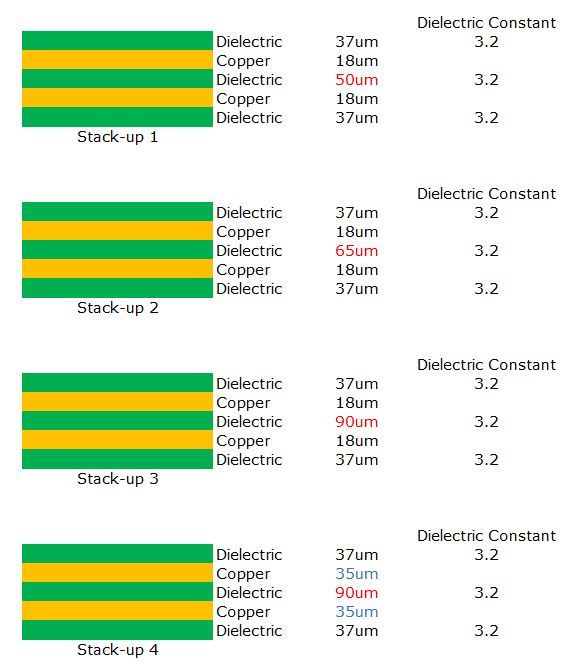
- Stacking 1: 70/130μm footprint/space
- Stack-Up 2: footprint/space 95/140μm
- Stack-Up 3: footprint/space 125/130μm
- Stack-Up 4: 105/150μm footprint/space
During production, manufacturers typically set process parameters after first article verification, then perform random impedance checks during production and on finished boards.
Manufacturing Capabilities for Impedance Control PCBs
At EBest Circuits (Best Technology), we support controlled impedance PCB manufacturing for a variety of applications, from prototyping to volume production.
Typical Abilities Overview
| Goods | Ability |
| Board Type | Rigid PCB, multilayer PCB, HDI PCB, RF PCB |
| Number of Layers | Typical 1–32 layers |
| Controlled Impedance Type | Single ended and differential |
| General Target Value | 50Ω / 75Ω / 90Ω / 100Ω / 120Ω |
| Basic material | FR4, high speed material, RF lamination |
| Copper Thickness | Standard to heavy duty copper options |
| Impedance Verification | Coupon/control testing in progress |
| Application Support | RF, telecommunications, automotive, industrial, medical |
Impedance Control PCB Applications
Controlled impedance PCBs are widely used in products where signal integrity is a priority.
Typical applications include:
- Communication equipment
- RF Module
- Automotive electronics
- Medical devices
- Industrial control systems
- Network hardware
- Embedded computing platform
- High-speed data transmission system
As product speed and complexity continues to increase, controlled impedance is becoming a standard requirement in more electronics categories.
FAQ About Impedance Control PCB
1. What is the difference between impedance control and standard PCB design?
Standard PCB designs may not specify strict trace impedance targets. Impedance control PCB designs require certain trace widths, spacing, material selection and stack planning to achieve specified impedance values.
2. Is FR4 suitable for impedance control PCB?
Yes. FR4 can be used for many controlled impedance applications, especially general digital designs. For higher frequencies or lower signal loss requirements, specialty materials may be a better choice.
3. What are the most common differential impedance values?
A differential impedance of 100Ω is one of the most common targets, especially for many high-speed signal interfaces.
4. Can impedance control PCB reduce EMI?
Yes. Stable impedance routing can reduce signal reflections and discontinuities, thereby helping to improve overall signal integrity and can support better EMI performance.
5. How is impedance tested during manufacturing?
Manufacturers typically use impedance coupons and random process checks during production, followed by final board verification.
6. What tolerances are usually acceptable?
Typical impedance tolerances are ±10%, while stricter requirements such as ±5% may be used in more demanding applications.
Get a Quote for Your Impedance Control PCB Project
If you are developing a high-speed or RF product, controlled impedance should be considered early in the design phase. Proper stacking and manufacturable tracing structures can save time and cost of revisions later on.
EBest Circuits (Best Technology) provides impedance control PCB manufacturers with engineering overview, stack support and reliable process control for demanding electronic applications.
Send us your Gerber files, layer layouts, and impedance requirements, and our team will help you move your project forward with more confidence.
Tags: controlled impedance PCB, impedance control on PCB, impedance control PCB, impedance control PCB design
This entry was posted on Friday, April 10, 2026 at 18:56 and is filed under Custom PCB. You can follow any responses to this entry via the RSS 2.0 feed. You can skip to the end and leave a response. Ping is currently not allowed.
PakarPBN
A Private Blog Network (PBN) is a collection of websites that are controlled by a single individual or organization and used primarily to build backlinks to a “money site” in order to influence its ranking in search engines such as Google. The core idea behind a PBN is based on the importance of backlinks in Google’s ranking algorithm. Since Google views backlinks as signals of authority and trust, some website owners attempt to artificially create these signals through a controlled network of sites.
In a typical PBN setup, the owner acquires expired or aged domains that already have existing authority, backlinks, and history. These domains are rebuilt with new content and hosted separately, often using different IP addresses, hosting providers, themes, and ownership details to make them appear unrelated. Within the content published on these sites, links are strategically placed that point to the main website the owner wants to rank higher. By doing this, the owner attempts to pass link equity (also known as “link juice”) from the PBN sites to the target website.
The purpose of a PBN is to give the impression that the target website is naturally earning links from multiple independent sources. If done effectively, this can temporarily improve keyword rankings, increase organic visibility, and drive more traffic from search results.
