What is electronic component failure?
When every part in the electronic system stops working as expected, it is called the failure of electronic components. This can mean the capacitor no longer holds the charge, a burning resistor, or damage to the integrated circuit. Even a small component that is wrong can cause big problems in the final product.
To find out why the component fails, engineers use a process called electronic component failure analysis. This process involves visually checking parts and electricity, identifying how and why errors occur, and use that information to avoid similar problems in the future. It is very important for quality assurance, product reliability, and cost control in any electronic business.
Type of electronic component failure
Electronic components can fail in different ways depending on the pressure they experience. Below are the four most common types:
1. Mechanical failure
Mechanical failure occurs when there is physical damage from the component structure. Some failures are often caused by vibrations, inappropriate treatment, or dropping the device. In cellular or automotive electronics, this type of failure is very common because of frequent movements. Typical failures include:
- Cracked solder connection
- Damaged lead or pin
- Cracked PCB substrate
- Loose connector due to vibration
You might see components that are no longer connected properly to the board or part that moves when touched. Visual inspection often reveals cracks or loosened parts caused by physical force.
2. Thermal failure
All electronic parts produce heat when operating. However, if the heat is not controlled properly, the component can be too hot and damaged. This is known as thermal failure.
For example, semiconductors such as transistors and integrated circuits are sensitive to high temperatures. When they become too hot, their internal structure can be damaged, causing permanent damage.
3. Failure of aging
Components have a natural age. Over time, materials are degraded, and components can no longer function correctly. This is called aging failure.
Electrolytic Capacitors are well-nown for this issueâ € “they tend to dry out after years of use, causing them to lose their ability to hold charge. Similarly, soldering joints can crack after repeated heating and cooling cycles. Connections.
- Metal fatigue on the soldering connection
- Reduction of battery capacity
- Dielectric layer worsening
4. Packaging failure
Closed electronic components in packaging to protect inside material. If the packaging is defective or damaged when used, it can expose components in humidity, dust, or chemicals.
For example, water vapor can absorb through a cracked case chip and cause corrosion in it. This is very risky in a humid or corrosive environment. Packaging failures are often seen as cracks, blisters, or outer shell delamination.
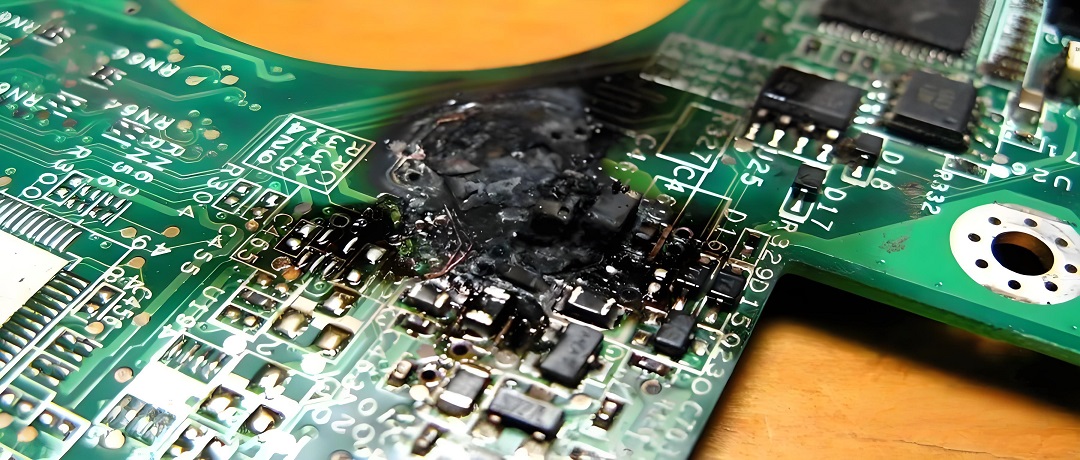
The cause of electronic component failure
To solve problems effectively, it is important to understand the root of the cause behind failure. Below is the most common cause faced by engineers during the analysis of electronic component failures:
1. Stress upright and excessive current
Each electronic component has a maximum voltage and current ranking. Beyond these limits can damage the internal structure, often cause immediate failure. For example, sending too much current through a resistor can cause it to be too hot and burning. Applying excessive voltage to the capacitor can cause it to explode or leak.
2. Poor solder or manufacturing defects
The wrong assembly technique can cause short circuits, intermittent connections, or component movements. Cold soldering joints’ where solder does not melt completelyâ € “can crack over time.
If a component is not in harmony or is not soldered properly for all its bearings, it may not function or may fail under mechanical pressure. This defect is usually captured through visual inspection or X-ray analysis.
3. Electrostatic discharge (ESD)
Static electricity may not hurt humans, but can destroy sensitive components such as mosfet and ICS instantly. Even small ESD events can damage internal intersections, creating invisible mistakes that appear later during use.
4. Environmental stress
Humidity, dust, salt, or chemicals in the air can damage the metal parts, especially in the outside or industrial environment. Extreme temperatures or thermal cycles that can often press the material, causing them to crack or delamination.
5. Inadequate design or selection of components
Using the wrong part for the job – such as a low voltage capacitor in the high voltage section ‘can cause initial failure. Likewise, ignoring the rules of the digging (the operating part near the limit) can reduce age dramatically.
How do I check the wrong electronic components?
When the device is not functioning, check the components one by one is a logical step. This is how to do it effectively:
1. Visual inspection
The first step is to always look careful. Use a magnifying glass or microscope if needed. There are several signs that can be checked directly if the component fails. Look for:
- Burning marks or color changes
- Cracked or broken leg
- Capacitors bulging or leaking
- Solder connection lifted or cracked
- Curved or melt
2. Smell
The burning electronic part releases a strong aroma. If the board smells like plastic or metal burned, you may be close to the damaged part.
3. Touch test (with care -heart)
After the power turns off and the board is safe to handle, you can gently feel the component. If someone feels much hotter than the others, it might fail. Never touch the live circuit, and be careful even when the power is released ‘capacitors may still have a charge.
4. Comparison Method
If you have an identical work tool, compare with the wrong. Exchange parts one by one can help isolate which components are not functioning.
5. Multimeter testing
Digital multimeter is your best tool. You can test open circuits, shorts, or measure resistance, voltage, and continuity. We will explain this in the next section in detail.
How to prevent electronic component failure?
Although you cannot prevent all failures, many of them can be avoided with good design, handling, and maintenance practices.
- Always the source of your components from leading suppliers. The cheap or fake part is much more likely to fail.
- Avoid encouraging components near the max voltage, current, or temperature limit.
- Add surge (such as diode or TV fuse) protection if needed.
- Use the appropriate PCB layout technique for signal integrity and thermal control.
- Use the wrist and anti-static mats when handling sensitive parts.
- Save components in an anti-static bag or box.
- Avoid touching the component pin directly.
- Good polishing practices and correct part orientation are very helpful. Automatic Optical Inspection (AOI) and In-Sirkit (ICT) testing helps ensure quality during production.
- For circuits that are exposed to moisture or dust, apply conformal layers or pots to prevent corrosion and shorts. Use the proper IP ranking if the device will be outdoors.
- Use heatsinks, thermal vias, fans, or thermal pads to keep the part cool. High temperatures shorten the life life of more than almost all other factors.
How do you test electronic components with a multimeter?
Multimeter is one of the most useful tools for checking components, can be tested various parts, here are how to test:
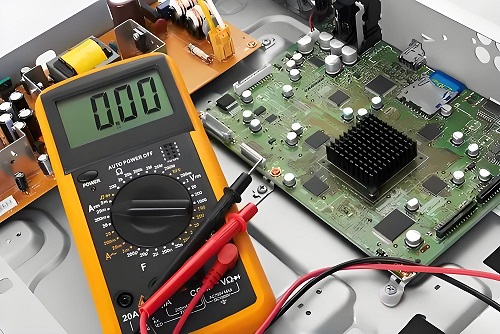
1. Testing capacitor
- Discard the capacitor before testing.
- Set the multimeter mode to capacitance (if available).
- Connect Probe to Lead.
The big difference between reading value and value indicates aging or failure.
Note: If your multimeter has no capacitance mode, you can test short conditions or open using resistance mode.
2. Testing Diode and LED
- Set the meter test mode to the diode.
- Connect the red probe to the anode and black to the cathode.
- A good diode must show a decrease in ahead voltage (~ 0.6â € “0.7V).
- Turning probe should not show reading.
LEDs can also be tested in this way, and vague lights can even blink when tested in the future.
3. Transistor testing
Bipolar intersection transistors (BJTS) can be tested by checking the base-emitter and basis intersections such as diode.
- Use diode mode.
- Base-to-Emitor and base-to-collector’s testers and each must show ~ 0.6V in the future bias.
- Probe reversed or collectors-to-emitor does not show conduction.
- If you get reading in all directions, the transistor can be abbreviated.
4. Test IC
Integrated circuit is difficult to test only with a multimeter. You usually need to give power to the board and check the input/output signal or use a special IC examiner.
FAQ
1. What is the first sign of electronic component failure?
Signs of burns, strange odors, or non -functioning behavior are the initial signs of common component problems.
2. How do you test electronic components without releasing it from the circuit?
You can test many components in the circuit using a multimeter, but the reading can be influenced by parallel components.
3. How often do electronics should be checked for the aging component?
Important systems must be checked every year, while consumer devices may only require services after a few years.
4. What is the role of deating in preventing failure?
De rarating means the operating component is below its maximum limit to reduce stress and increase reliability.
5. Can fail analysis increase product design in the future?
Yes, analyze parts that fail to help engineers improve design, choose better materials, and increase overall endurance.
If you are working on repairs or want to increase the reliability of your product, the analysis of the right electronic component failure is a valuable step. Want help with a reliable PCB failure or assembly diagnostic? Achieve the best technology-your trustworthy for high-quality certified PCB and PCBA solutions.
We follow strict quality control with a quality control system, and offer full lacking for manufacturing, reports, data sheets … If you want to do PCB assembly or component sources, welcome to contact us at [email protected].
Tags: Analysis of electronic component failures
This entry is posted on æÿœœäº “, 18 7 æœatra, 2025 at 6:43 下 Å ˆ and submitted under the best PCB, BestTPCB, FAQ, PCB news. You can follow any response to this entry via RSS 2.0 feed. You can leave a response, or trackback from your own site.
Game Center
Game News
Review Film
Berita Olahraga
Lowongan Kerja
Berita Terkini
Berita Terbaru
Berita Teknologi
Seputar Teknologi
Berita Politik
Resep Masakan
Pendidikan
Berita Terkini
Berita Terkini
Berita Terkini
review anime
Gaming Center
Originally posted 2025-07-19 03:33:00.
