What is a motherboard and why is it called a mainboard?
The motherboard is the central printed circuit board that connects every major component in the computer. It acts as the electrical and mechanical foundation on which the processor, memory, storage interfaces, and expansion devices communicate via controlled signal paths. The term main board originates from early computer architecture, where one main board coordinated multiple secondary cards. Over time, these main control boards evolved into the highly integrated platforms we now call motherboards.
In modern systems, the motherboard is not just a passive connector. It integrates a power regulation module, high-speed data bus, firmware control, and thermal management features. Without it, individual components cannot exchange data or operate in a synchronized manner.
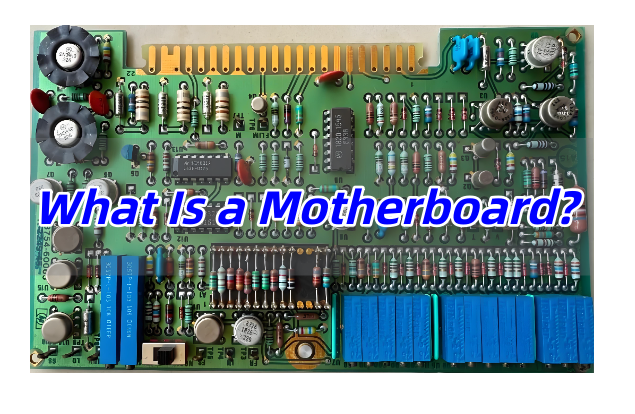
What components are found on the motherboard?
A typical motherboard combines several functional zones, each designed for a specific electrical and mechanical role. Understanding this section helps beginners visualize how the entire system operates.
Common motherboard components include:
- CPU socket – An interface that houses the processor and transmits power and signals through a dense array of pins.
- chipset – A controller hub that manages communications between the CPU, memory, storage, and peripheral devices.
- DIMM slots – Memory connectors are designed for controlled impedance and high frequency signal integrity.
- VRM (Voltage Regulator Module) – Converts input power into the stable voltage required by the CPU and GPU.
- PCIe slots – High-speed expansion interface for graphics cards, AI accelerators or network modules.
- Storage Connector – SATA port and M.2 slot enable SSD and HDD integration.
- BIOS/UEFI chips – Firmware storage that initializes hardware during system startup.
- Rear I/O Ports – External interfaces such as USB, Ethernet, audio and video output.
Each element is strategically placed to balance thermal airflow, signal route length, and electromagnetic compatibility.
How does a motherboard work in a computer system?
The motherboard operates as a complex communications network. Instead of moving data randomly, it routes information through predetermined paths called buses and layers in the PCB stack.
When the computer turns on, the firmware activates the CPU and checks the connected devices. The chipset coordinates traffic between components. For example, when software is loaded from an SSD, the motherboard routes data from storage via PCIe lanes to the processor and then to the memory module.
Electrical power distribution is equally important. VRM converts raw power from the power supply into precision voltage rails. These rails must remain stable even under heavy computing loads. The high-quality motherboard design uses multiphase power circuitry and thick copper layers to reduce heat and electrical noise.
Modern boards also support advanced features such as:
- High-speed DDR memory signaling
- Multi-layer impedance control
- Thermal sensors and fan control logic
- Firmware-based hardware monitoring
Together, these functions turn the motherboard into the coordinating center of the entire computer.
Types of Motherboards
Motherboards vary widely depending on device size, performance targets, and application environment. Engineers often classify them based on form factor and usage scenario.
Common motherboard categories:
| Type | Typical Use | Characteristics |
| ATX | Desktop PCs | Balanced expansion slots and cooling space |
| Micro-ATX | Compact desktop | Reduced size with moderate expansion capabilities |
| Mini-ITX | Small system | Minimal footprint, limited slots |
| Motherboard Server | Data center | Multi-CPU support, ECC memory |
| Industrial Motherboards | Automation system | Long life cycle, sturdy design |
The form factor determines mounting holes, connector placement, and airflow design. It also affects the number of PCB layers and routing complexity.
Why is Motherboard PCB Design Important for Performance?
Motherboard performance is closely related to PCB engineering, not just component selection. High-speed signals travel through copper traces at gigahertz frequencies. Poor routing can cause signal reflections, crosstalk, or impedance mismatch.
Key PCB design considerations include:
- Layer stacking planning for controlled impedance
- Separation of electrical fields to minimize noise
- Thermal via array for heat dissipation
- Differential pair routing for PCIe and USB interfaces
- Ground reference integrity to maintain signal stability
Advanced motherboard PCBs often use 6 to 14 layers or more. This layer allows engineers to separate power, ground, and data lines, ensuring reliable high-speed communications.
What Materials Are Used in Making Motherboards?
Most consumer motherboards are made using high-performance FR-4 laminate materials. However, not all FR-4 media are identical. Manufacturers select materials based on thermal stability, dielectric constant, and mechanical resistance.
Typical materials used:
- FR-4 Tg is high – Provides better resistance to heat during soldering and long-term operation.
- Low loss dielectric material – Used in high frequency servers or workstation boards.
- Copper Foil (1oz–2oz) – Determines current carrying capacity and thermal spread.
- Solder Mask & Silk Screen – Protects the circuit and guides the assembly process.
Server-class motherboards sometimes use low Dk materials to maintain signal integrity over long PCIe lanes, especially for AI or data center applications.
Desktop vs Server vs Industrial Motherboard — What’s the Difference?
Although all motherboards have similar architectures, their design priorities differ significantly depending on the application environment.
| Feature | Desktop Motherboard | Motherboard Server | Industrial Motherboards |
| Performance Focus | Games or daily tasks | High compute & uptime | Reliability & long life |
| Memory Support | Standard DDR | ECC registered memory | Often the configuration is fixed |
| Expansion | GPU-centric | Multiple PCIe lanes | Legacy interface is supported |
| Operating Environment | Controlled indoors | Data center rack | Harsh industrial conditions |
Desktop boards prioritize user customization. Server boards emphasize redundancy and remote management. Industrial boards focus on durability, extended supply cycles and stable operation in demanding environments.
How to Choose the Right Motherboard for Your Application?
Choosing a motherboard starts with determining system requirements, not just comparing brand names.
Consider these factors:
- Processor compatibility and socket type
- Memory capacity and speed
- Number of PCIe lanes required
- Thermal and airflow design
- Long term availability for industrial or embedded products
- Power delivery capability for a high-performance CPU or GPU
Engineers designing custom hardware often review the number of PCB layers and VRM layout because these parameters directly affect system stability during peak loads.
What Problems Do Beginners Often Face When Learning About Motherboards?
New learners often focus only on visible connectors and ignore electrical design principles. Some common challenges include:
- Confusing chipset role with CPU functionality
- Assuming all motherboards offer the same performance
- Ignores power delivery limitations
- Underestimating signal integrity requirements
- Misunderstanding of compatibility between form factors
Learning basic PCB architecture helps beginners understand why certain boards support higher memory speeds or more expansion devices.
What is the Difference Between Motherboard and PCB?
PCB refers to the physical board that houses the copper traces and electronic components. A motherboard is a special type of PCB specifically designed to integrate computing subsystems.
Main differences:
- PCBs can be simple or complex, used in any electronic device.
- The motherboard is a high-density, multi-layer PCB with integrated computing infrastructure.
- Motherboards require tighter impedance control, thermal management and power distribution compared to common PCBs.
In short, every motherboard is a PCB, but not all PCBs qualify as motherboards.
FAQs
1. Is the motherboard responsible for system speed?
Yes, indirectly. Although the CPU and memory determine raw performance, the motherboard design determines how efficiently these components communicate.
2. Can the motherboard be upgraded easily?
It depends on the system. Desktop boards are usually replaceable, while laptops and industrial systems often use fixed designs.
3. How many PCB layers do modern motherboards use?
Most consumer boards use 6-8 layers, while high-end server boards may exceed 12 layers to support complex routing.
4. Does motherboard size affect performance?
Size itself doesn’t increase speed, but larger boards usually allow for better power delivery and more expansion options.
5. Why are server motherboards more expensive?
It includes advanced reliability features such as ECC memory support, redundant power paths, and an extended validation process.
Tag: PCB Main Board
This entry was posted on Friday, February 6, 2026 at 18:53 and is filed under best PCB, best PCB, FAQ, FR4 PCB, PCBA. You can follow any responses to this entry via the RSS 2.0 feed. You can skip to the end and leave a response. Ping is currently not allowed.
News
Berita Teknologi
Berita Olahraga
Sports news
sports
Motivation
football prediction
technology
Berita Technologi
Berita Terkini
Tempat Wisata
News Flash
Football
Gaming
Game News
Gamers
Jasa Artikel
Jasa Backlink
Agen234
Agen234
Agen234
Resep
Cek Ongkir Cargo
Download Film
