Tantalum capacitors are polarized electrolytic capacitors used for DC power filtering, local energy storage and supply decoupling. They provide relatively high capacitance in compact packages, making them useful when PCB space is limited and predictable capacitance under operating voltage matters.
Growing demand for passive components has also brought tantalum capacitors into recent supply-chain discussions. At its October 29, 2026 earnings briefing, YAGEO outlined plans to increase capacity supporting demand for products including MLCCs and tantalum capacitors by approximately 10%–15%. Some additions are expected in the second quarter of 2027, with others arriving during the second half. This is a broader expansion plan—not a separately stated 15% increase for tantalum capacitors alone. Source: Central News Agency
For engineers and component buyers, the announcement raises a practical question: when should a tantalum capacitor be selected, and what must be checked before approving it for a PCB assembly?
The answer starts with the circuit—not the market headline.
Key Takeaways
- Tantalum capacitors provide compact bulk capacitance for suitable DC power circuits.
- Common surface-mount solid types use either manganese dioxide or conductive polymer cathode systems.
- Voltage derating, surge current, ESR, ripple heating and polarity must be evaluated together.
- Polymer tantalum capacitors generally offer lower ESR than comparable manganese dioxide products, but they are not automatic replacements.
- Tantalum capacitors and MLCCs can complement each other; equal nominal capacitance does not establish interchangeability.
- Capacity expansion does not guarantee immediate stock, lower prices or shorter lead times for a particular manufacturer part number.
What Is a Tantalum Capacitor?
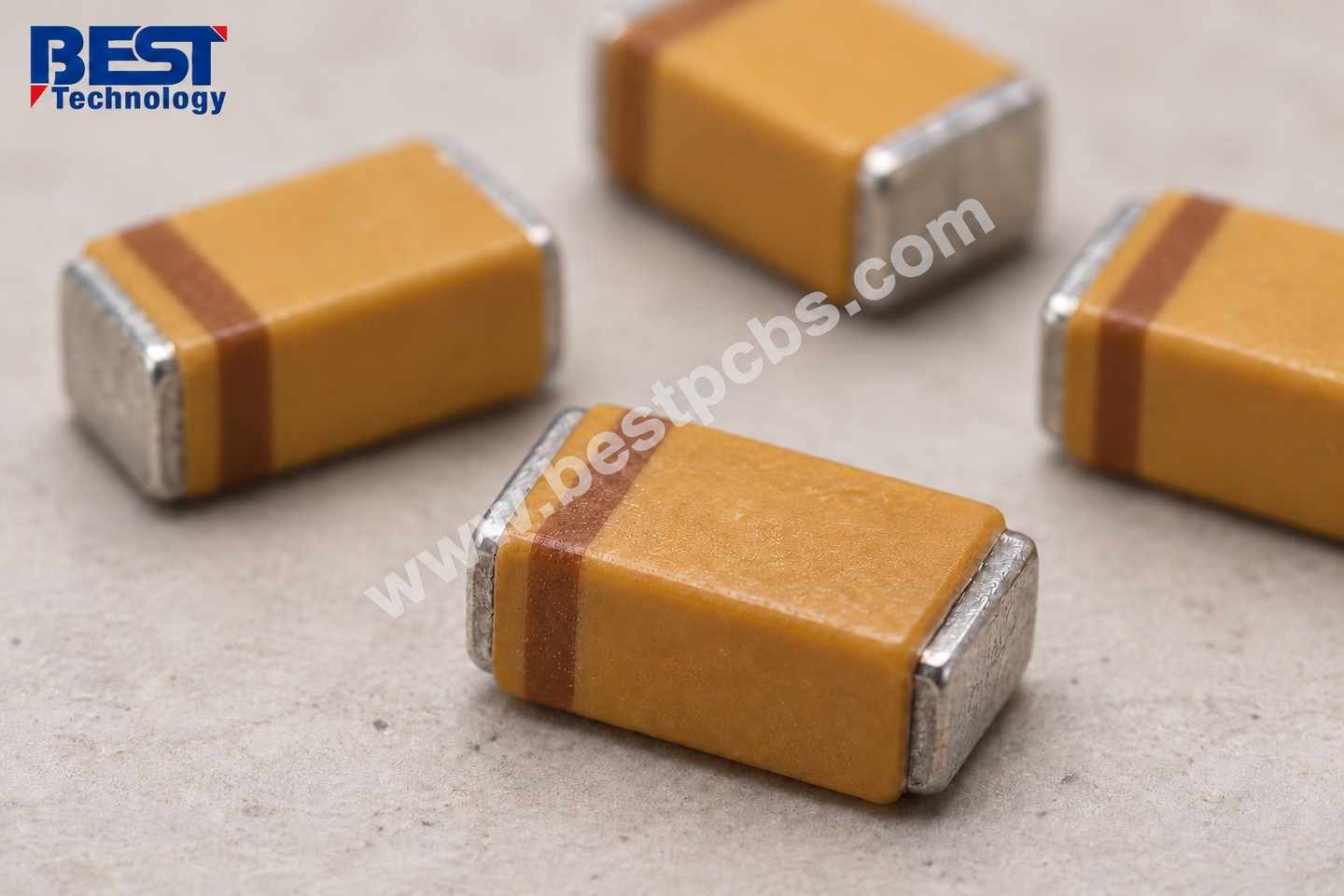
A tantalum capacitor is an electrolytic capacitor that uses tantalum as its anode material and tantalum pentoxide, Ta2O5, as its dielectric.
In common solid constructions, tantalum powder is formed into a porous anode. Its large internal surface area, combined with a thin oxide dielectric, allows relatively high capacitance within a small component.
The structure contains three essential elements:
- Tantalum anode: Provides the porous conductive structure.
- Tantalum pentoxide dielectric: Forms the insulating layer between the electrodes.
- Cathode system: Uses manganese dioxide or conductive polymer as part of the conductive structure surrounding the dielectric.
The resulting component has a defined positive and negative terminal. Correct polarity is therefore essential during both circuit design and assembly.
Tantalum capacitors are themselves electrolytic capacitors. In everyday comparisons, “tantalum versus electrolytic” usually means tantalum versus aluminum electrolytic.
Why Does Capacitance Stability Matter?
A capacitor’s nominal value does not always represent the capacitance available in the working circuit.
Class II ceramic capacitors, including X5R and X7R MLCCs, can lose effective capacitance under DC bias. Solid tantalum capacitors generally show much less capacitance change from this effect.
That can be useful when a circuit needs a predictable amount of bulk capacitance. However, stable capacitance does not automatically mean better overall performance. Frequency response, ESR, temperature, leakage and transient conditions still influence the choice.
What Are the Main Types of Tantalum Capacitors?
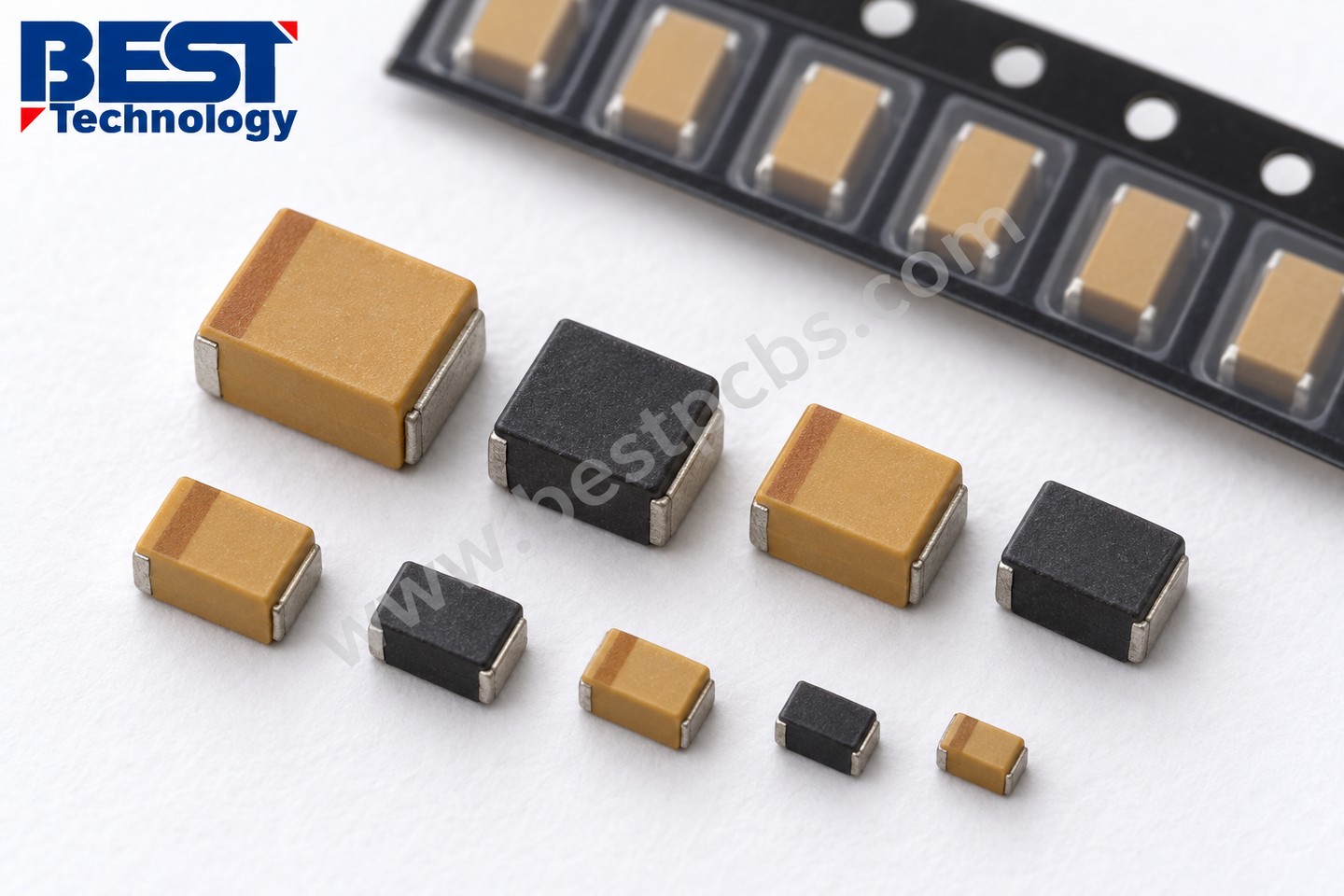
The two common surface-mount solid tantalum technologies are manganese dioxide and conductive polymer. Both use a tantalum anode and oxide dielectric, but their cathode systems give them different electrical characteristics.
| Feature | Manganese Dioxide Tantalum | Conductive Polymer Tantalum |
| Cathode system | Manganese dioxide, MnO2 | Conductive polymer |
| ESR | Generally higher than comparable polymer products | Generally lower |
| Polarity | Polarized | Polarized |
| Ripple-current capability | Depends on series and conditions | Often advantageous in suitable low-ESR series |
| Voltage derating | Series- and application-specific | Series- and application-specific |
| Important selection factors | Surge conditions, voltage margin and reliability requirements | ESR, ripple heating, leakage and environmental requirements |
Wet tantalum capacitors are another category, but this guide focuses on the solid surface-mount types commonly considered for PCB assemblies.
Manganese Dioxide Tantalum Capacitors
MnO2 tantalum capacitors are the conventional solid construction. They are available in different capacitance values, voltage ratings, package sizes and reliability grades.
They can be appropriate for DC filtering and energy-storage functions when operated within their application limits. Low-impedance supplies and rapid charging conditions require particular attention because they can expose the capacitor to substantial surge current.
Conductive Polymer Tantalum Capacitors
Polymer tantalum capacitors replace the manganese dioxide cathode system with conductive polymer. This generally lowers ESR and can reduce resistive losses in suitable power-filtering applications.
Lower ESR is not the only difference. Leakage specifications, temperature ratings, moisture-handling requirements and lifetime characteristics can also vary.
Choose the technology by the circuit’s requirements, then compare specific series. Neither construction is universally superior.
Where Are Tantalum Capacitors Used on PCBs?
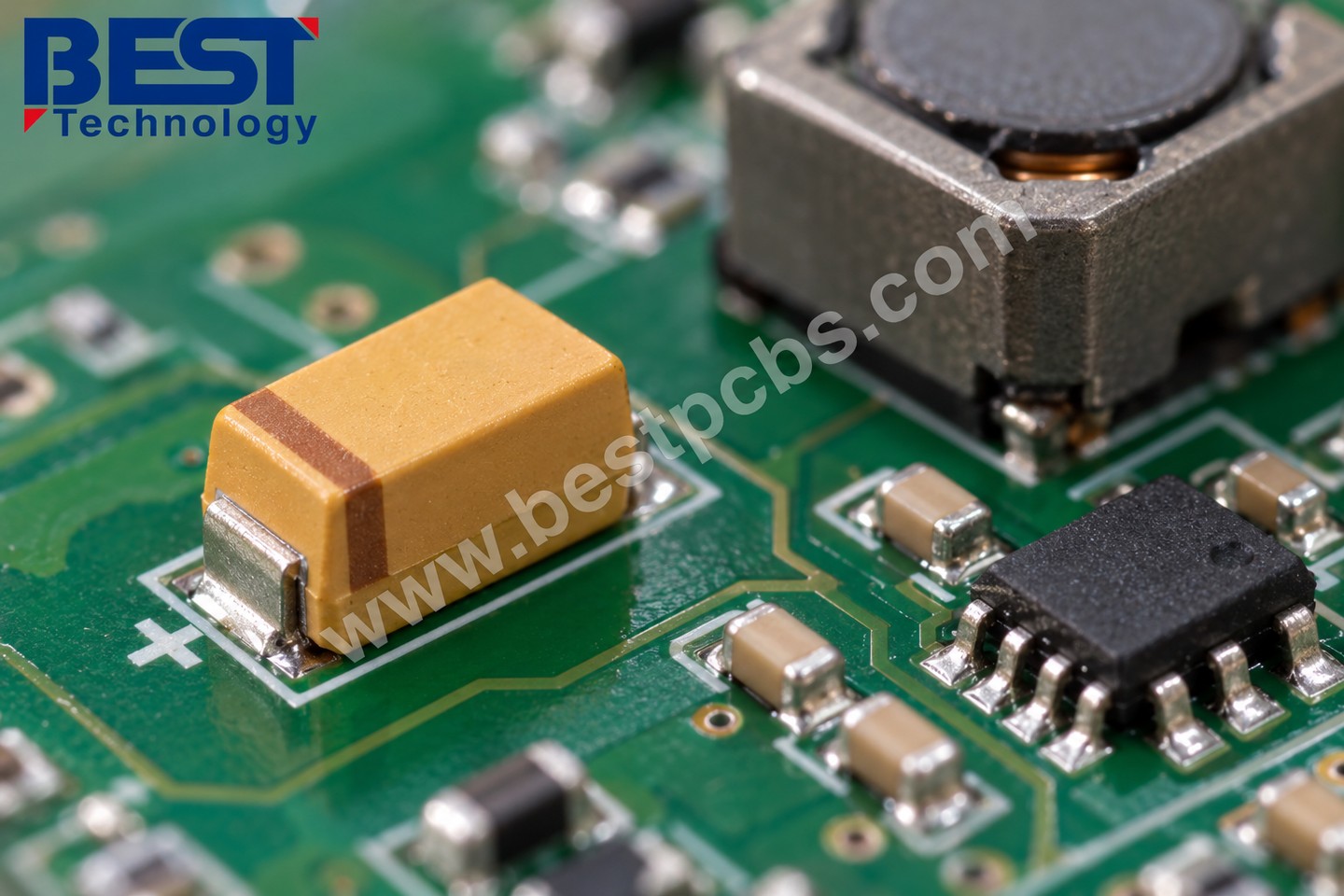
Tantalum capacitors are commonly considered for bulk capacitance, DC rail filtering and local supply support. Their usefulness depends on the required impedance over frequency and the available PCB space.
DC Power-Rail Filtering
A capacitor can supply charge during a brief increase in load current while the power source responds.
For example, an MCU control board might combine a bulk capacitor on the local supply rail with smaller ceramic capacitors near the processor’s power pins. The bulk component supports longer-duration current changes, while the nearby ceramics provide low-impedance paths at higher frequencies.
The MCU’s application guidance and the complete power network determine the necessary values and placement.
DC-DC Converter Input and Output Networks
A suitable tantalum capacitor may be used at a converter’s input or output, provided it meets the converter’s requirements.
At the input, the design must account for switching-current demands and startup stress. At the output, capacitance and impedance influence ripple, load-transient response and control-loop stability.
Some regulators require output capacitance within a particular ESR range. A lower-ESR replacement is therefore not automatically an improvement.
Space-Constrained Electronic Equipment
Tantalum capacitors can be useful in industrial controllers, communication modules, measurement equipment and selected computing power circuits where substantial capacitance must fit into a compact area.
An industrial data-acquisition board, for instance, may need local bulk capacitance while reserving board space for analog circuitry and connectors. A suitable surface-mount tantalum component may fit that requirement, subject to its electrical and height limits.
Higher-Reliability Applications
Selected tantalum capacitor series are designed for demanding applications, including automotive, medical and aerospace equipment.
The industry label alone does not establish suitability. Qualification documentation, operating temperature, electrical stress, mission profile and the exact component series must match the project.
At EBest Circuit, we support PCB fabrication, component sourcing and assembly. For boards using tantalum capacitors, the relevant manufacturing checks include the approved BOM, footprint, polarity, placement and assembly conditions. Our SMD capacitor guide explains related package and assembly considerations.
Why Are Manufacturers Expanding Tantalum Capacitor Capacity?
Manufacturers expand production when expected demand justifies additional capacity, equipment or process improvements.
YAGEO’s October 2026 briefing provides a recent example. The company identified AI applications as a demand driver for both MLCCs and tantalum capacitors and outlined phased capacity additions during 2027.
For component buyers, the timing is as important as the percentage. Announced capacity passes through installation, production ramp-up and product-specific availability before it can support an actual purchase order.
Three distinctions matter:
- Demand growth is not universal shortage. A strong market for selected products does not prove that every capacitance value, voltage rating or package is difficult to source.
- Planned capacity is not current inventory. An expansion expected next year cannot fill an immediate production shortage.
- Capacity growth does not determine every price. Purchasing conditions still depend on the approved part number, order quantity, supplier arrangements and delivery requirements.
The useful response is to identify components with limited alternatives, confirm written delivery conditions and review substitute parts before the production schedule becomes dependent on one source.
How Do You Select a Tantalum Capacitor?
Select a tantalum capacitor by evaluating electrical performance, reliability, mechanical fit and assembly requirements together.
Capacitance and Tolerance
Start with the minimum capacitance required by the circuit, including component tolerance and relevant operating conditions.
For a short interval during which the capacitor supplies an approximately constant current, a first-order estimate is:
ΔV ≈ I × Δt / C
Where:
- ΔV is the magnitude of the capacitive voltage change in volts;
- I is the current supplied by the capacitor in amperes;
- Δt is the duration in seconds;
- C is capacitance in farads.
As an illustration, an ideal 47 µF capacitor supplying 0.1 A for 100 µs would experience approximately 0.21 V of capacitive voltage change.
This is not a complete power-rail calculation. The actual waveform also depends on ESR, inductance, other capacitors and the regulator’s response.
Rated Voltage and Derating
Determine the maximum voltage the capacitor will experience—not just the nominal rail voltage.
Include:
- Continuous DC voltage;
- Startup overshoot;
- Switching transients;
- Operating temperature;
- Repeated charging conditions.
Voltage derating reduces the applied voltage relative to the rated voltage to provide an appropriate operating margin. The required margin depends on the technology, series and application.
For example, a 10 V-rated device may be an initial candidate for a nominal 5 V rail, but that does not establish suitability. The selected series must also tolerate the rail’s maximum voltage and transient conditions.
ESR and Impedance
Equivalent series resistance contributes to voltage variation and internal loss.
For an ESR-only estimate:
ΔVESR ≈ ΔI × ESR
Here, ΔI is the current change through the capacitor and ΔVESR is the corresponding resistive voltage step.
For sinusoidal ripple, RMS current multiplied by ESR gives the ESR-related RMS voltage component. Peak, peak-to-peak and RMS values should not be mixed.
Total impedance also includes capacitive and inductive behavior. Compare the component’s characteristics across the frequencies relevant to the circuit.
Ripple Current and Temperature Rise
Ripple current produces internal heating. A first-order resistive-loss estimate is:
P ≈ IRMS2 × ESR
Use ESR at the relevant frequency and temperature. For ripple containing several significant frequency components, losses should be assessed across those components rather than assuming one ESR value describes the entire spectrum.
Compare the expected losses and temperature rise with the component’s ratings and application guidance.
Inrush and Surge Current
Rapidly connecting a discharged capacitor to a low-impedance source can produce a large charging current.
Review the startup waveform, source impedance, current limiting and repetition rate. A capacitor operating below its voltage rating can still experience unacceptable startup stress.
This is especially important at hot-plug inputs or directly connected power sources. Do not assume that normal steady-state operation proves safe power-on behavior.
Package and PCB Footprint
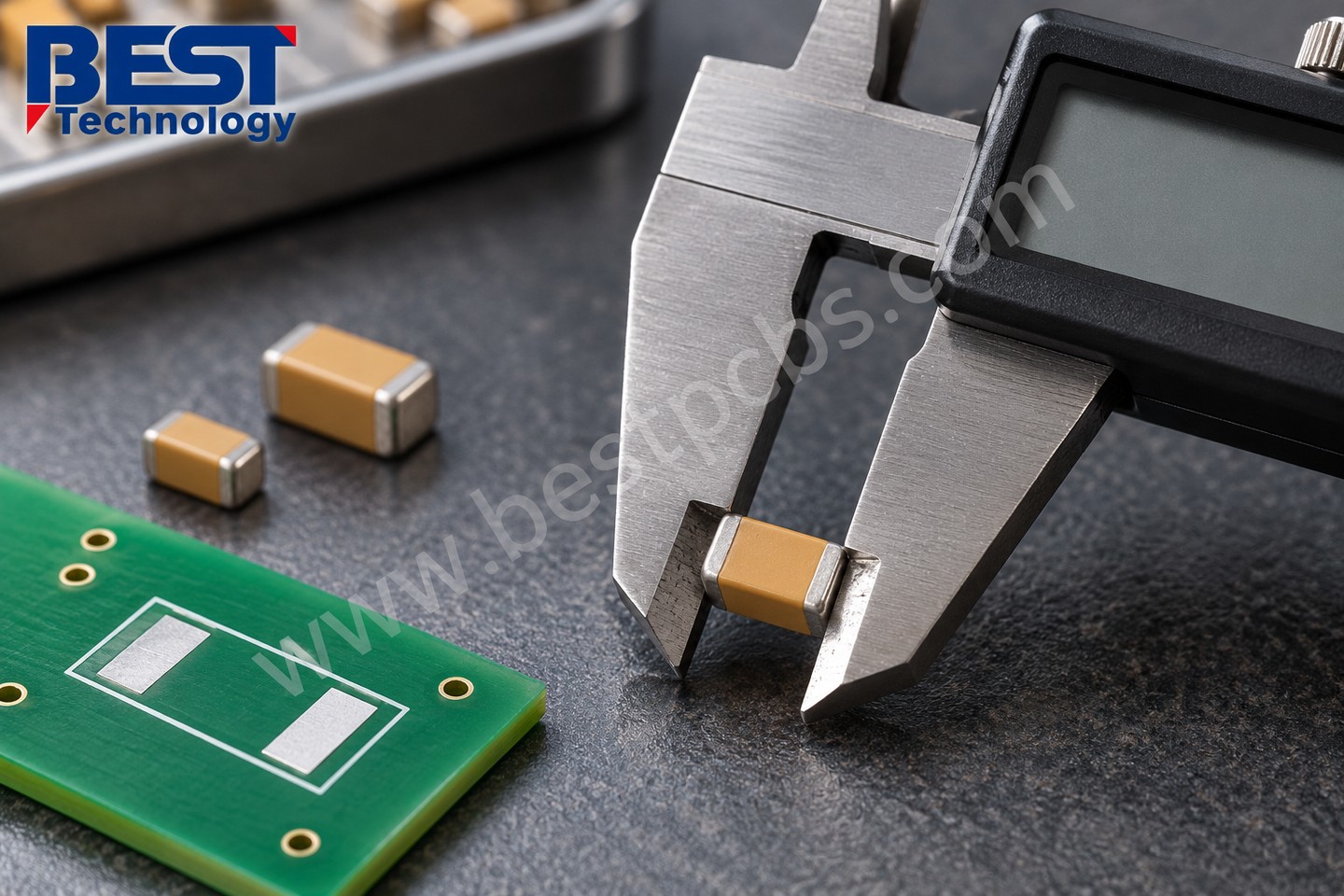
Confirm the actual manufacturer drawing and recommended land pattern.
Check:
- Body length, width and height;
- Terminal dimensions;
- Pad geometry;
- Polarity orientation;
- Clearance from nearby parts;
- Inspection and rework access.
A matching case designation does not remove the need to verify the selected component’s dimensions.
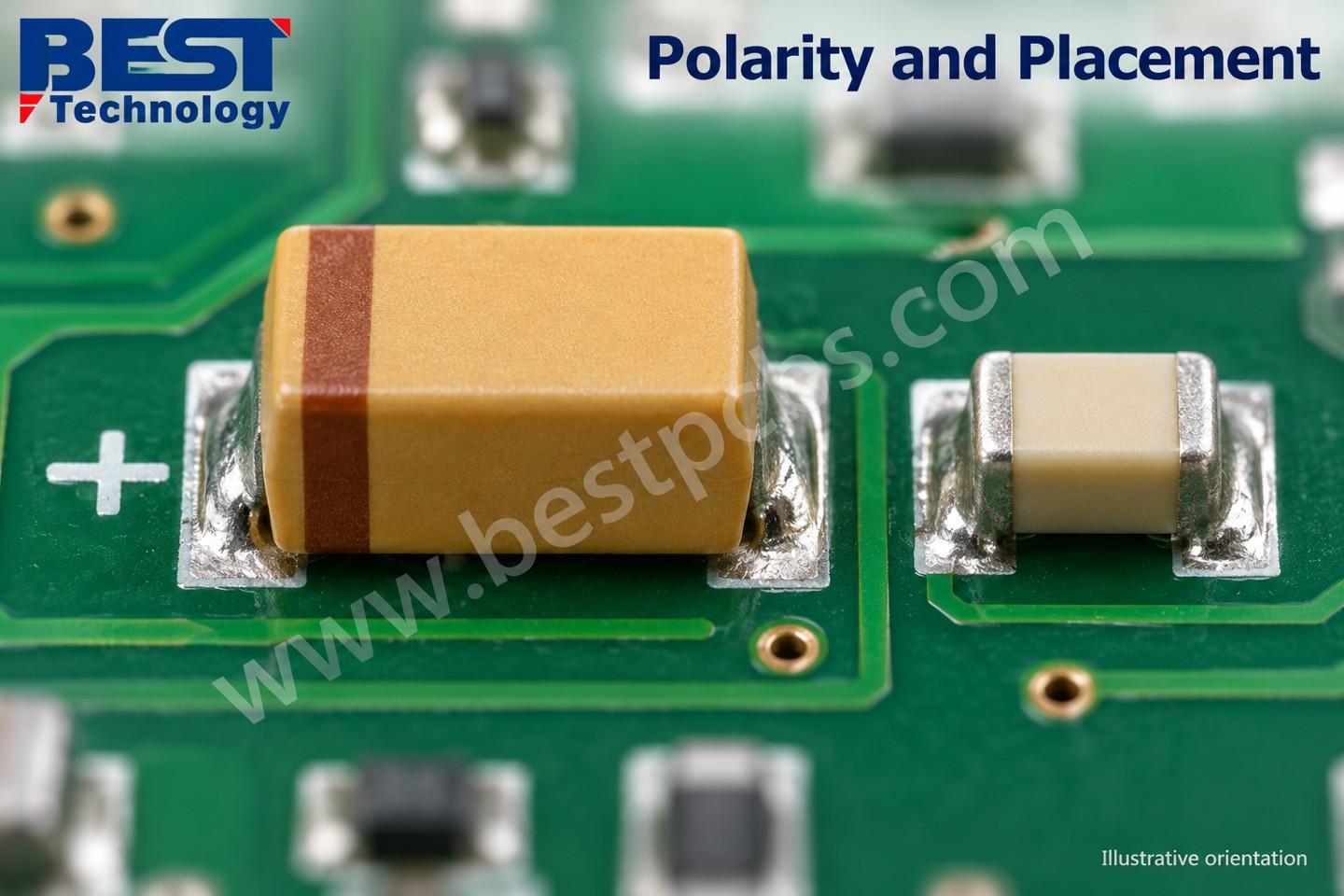
Polarity and Assembly Conditions
Tantalum capacitors must be installed in the correct orientation. Check the marking convention for the exact series rather than borrowing the convention from an aluminum electrolytic capacitor.
Assembly documentation should identify the permitted reflow profile, storage conditions, moisture handling where applicable, cleaning restrictions and rework limitations.
Example: Preparing a Selection Specification
Consider a control board with a nominal 5 V supply that needs additional local bulk capacitance.
| Parameter | Initial Design Information |
| Supply voltage | 5 V DC nominal; maximum and transients still to be established |
| Function | Local bulk filtering |
| Initial capacitance target | 47 µF |
| Rated voltage | Selected after derating and transient review |
| ESR | Compatible with the regulator and transient requirements |
| Temperature range | Defined by the product environment |
| Package | Fits the available area and height |
| Assembly process | Compatible with the specified SMT process |
This table defines the selection task; it does not approve a component.
The engineer must still compare candidate datasheets and validate startup, load transients, ripple and temperature on the actual design.
Can Tantalum Capacitors Replace MLCCs?
They can in some circuits, but equal nominal capacitance and voltage ratings do not make them interchangeable.
| Factor | Tantalum Capacitor | MLCC |
| Polarity | Polarized | Generally non-polarized |
| DC-bias capacitance change | Usually relatively small | Can be significant in Class II dielectrics |
| ESR | Depends on electrolyte and series | Typically low |
| High-frequency local decoupling | Depends on impedance and package | Often well suited |
| Replacement checks | Surge, voltage margin, leakage and polarity | Effective capacitance, dielectric, package and mechanical stress |
A Class II MLCC may provide less effective capacitance under operating voltage than its nominal value suggests. A tantalum capacitor may retain more of its capacitance, but it introduces different polarity, surge and impedance requirements.
In many power networks, the technologies work together: a bulk capacitor supports the rail while smaller ceramics provide local high-frequency decoupling.
Before substitution, verify effective capacitance, impedance, regulator stability, polarity, footprint and reliability requirements. Our MLCC guide provides further background on ceramic capacitor selection.
What Should Buyers Confirm Before Ordering?
The full manufacturer part number should anchor every procurement decision.
A purchasing record should establish:
- Component identity: Manufacturer, series and complete ordering code.
- Electrical requirements: Capacitance, tolerance, voltage, ESR, leakage and ripple-current limits where specified.
- Mechanical requirements: Package, height, footprint and polarity.
- Application requirements: Temperature range and any required qualification or screening.
- Supply conditions: Orderable quantity, MOQ, delivery schedule and quotation validity.
- Traceability: Approved sourcing channel and required supporting documentation.
- Assembly format: Packaging, reel orientation and handling requirements.
- Alternatives: Approved substitute MPNs and the authorization process.
A distributor’s available stock is useful only if the offered component matches the approved requirement. A similar description or shortened part number is not enough.
When substitutions are proposed, engineering approval should come before purchase. Customer approval may also be required for a controlled BOM.
FAQs About Tantalum Capacitors
How do you identify tantalum capacitor polarity?
Many molded surface-mount tantalum capacitors mark the positive terminal with a band or other indicator. Tantalum capacitor markings vary, so confirm the exact series documentation and match it to the PCB assembly drawing. Do not assume every capacitor stripe identifies the negative terminal.
Can tantalum capacitors be connected directly to a hot-plug power input?
Not without checking the electrical stress. Hot-plug operation can create voltage overshoot and high charging current. Suitability depends on the capacitor series, source impedance, protection and startup conditions.
Can polymer tantalum replace manganese dioxide tantalum?
Possibly, but the change requires review. Differences in ESR, leakage, ripple capability, voltage requirements, environmental behavior and package dimensions can affect the circuit.
How should a suspected failed tantalum capacitor be tested?
Disconnect power and discharge the circuit safely before investigation. A low-resistance reading on an assembled board does not identify the capacitor by itself because parallel circuitry affects measurements. Diagnosis may require isolating the part and checking capacitance, ESR or leakage under controlled conditions.
What makes two apparently similar tantalum capacitor MPNs non-interchangeable?
They may differ in electrolyte technology, ESR grade, tolerance, voltage, temperature rating, qualification, surge screening, dimensions or packaging. Matching only capacitance and rated voltage leaves important requirements unchecked.
Choosing Tantalum Capacitors for Reliable PCB Assembly
Tantalum capacitors remain useful where compact bulk capacitance and relatively stable capacitance under DC bias fit the circuit’s needs. Selecting between MnO2 and polymer products requires attention to voltage margin, surge current, ESR, ripple heating and assembly conditions.
Recent expansion announcements highlight demand for passive components, but reliable procurement still depends on the exact approved part and confirmed delivery conditions.
At EBest Circuit, we support component sourcing, PCB fabrication and PCB assembly. Send your BOM, Gerber files, assembly drawings, quantities and delivery requirements to [email protected] so our team can review the project’s sourcing and manufacturing needs.
Tags: polymer tantalum capacitors, tantalum capacitor markings, tantalum capacitor polarity, Tantalum Capacitors, what is a tantalum capacitor
PakarPBN
A Private Blog Network (PBN) is a collection of websites that are controlled by a single individual or organization and used primarily to build backlinks to a “money site” in order to influence its ranking in search engines such as Google. The core idea behind a PBN is based on the importance of backlinks in Google’s ranking algorithm. Since Google views backlinks as signals of authority and trust, some website owners attempt to artificially create these signals through a controlled network of sites.
In a typical PBN setup, the owner acquires expired or aged domains that already have existing authority, backlinks, and history. These domains are rebuilt with new content and hosted separately, often using different IP addresses, hosting providers, themes, and ownership details to make them appear unrelated. Within the content published on these sites, links are strategically placed that point to the main website the owner wants to rank higher. By doing this, the owner attempts to pass link equity (also known as “link juice”) from the PBN sites to the target website.
The purpose of a PBN is to give the impression that the target website is naturally earning links from multiple independent sources. If done effectively, this can temporarily improve keyword rankings, increase organic visibility, and drive more traffic from search results.
